

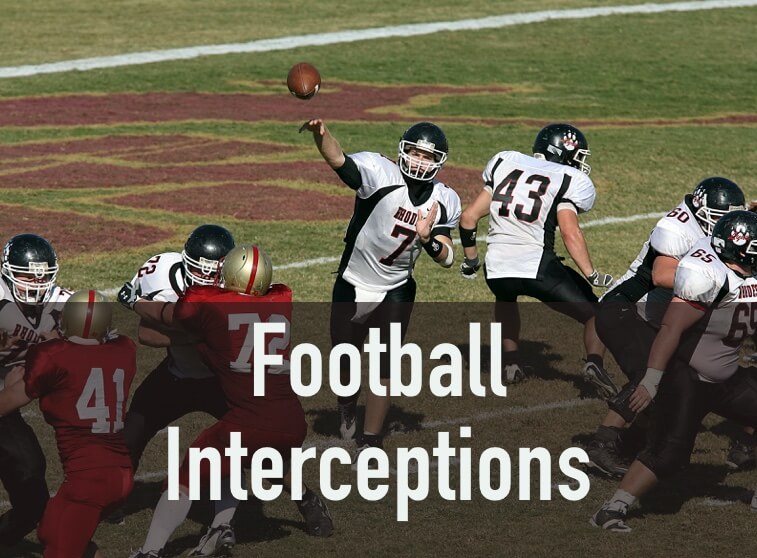
One of the most exciting plays in all of football is when a defense can create a turnover. Turnovers generally have huge role in determining who will end up winning the football game and who doesn’t.
One of the most common and exciting turnovers in football is what is called an interception. So, you might be wondering what is an interception in football?
An interception (INT) or pick in football is when a defensive player catches a forward pass that is thrown by the other team’s quarterback or another offensive player. After an interception is made the defensive player (if not down) can attempt to run towards the other teams endzone. If the defensive player is tackled, his team will take over at the spot where the defensive player was downed.
For example, A corner who is guarding a wide receiver jumps in-front of his opponent and catches the ball. This is an interception and he can run toward the endzone until he is tackled. Once he is down his offensive team will take possession of the ball.
For more in-depth information about what an interception is and why they are important in football, please continue reading below.
A Football Interception

To get a better idea of what exactly is an interception and how it is determined let’s take a look at the exact definition from the NFL rulebook.
“An interception is made when an opponent who is inbounds catches a forward or backward pass or a fumble that has not touched the ground.” (Source: NFL Rules)
You’ll notice some important distinctions in this definition. A defensive player must maintain full control and possession of the football while inbounds.
In the NFL a player must have 2 feet in bounds and maintain possession of the ball all the way until the ground for it to be considered an interception. In college football a player only needs to have 1 foot inbounds while maintain possession.
Interceptions are in important statistical number in football both for defensive players as well as the quarterbacks who are throwing them.
You will often hear announcers or fans refer to interceptions as INT’s or picks. Both of these terms are just another way to say an interception has been thrown.
What Happens After an Interception?
As soon as a defensive player has intercepted the ball his team will immediately start blocking for him to allow him to gain as much yardage as possible and perhaps run it back for a touchdown (commonly referred to as a pick 6).
The offensive team at the same time will immediately attempt to tackle the interceptor or attempt to strip the ball away to regain possession of the football.
If the interceptor doesn’t end up scoring and is tackled by his opponent his offensive team will take possession of the ball and the ball will be placed where he was downed.
Here is a look at some of the greatest NFL interceptions of all-time:
What is a Pick 6?
A pick six is a term in football that is used when a defensive player picks or intercepts a forward pass from an offensive player and returns it for a touchdown.
A pick six is what every defensive player dreams about and hopes to accomplish while on the football field. These can be one of the most exciting plays in football and can play a huge factor in the outcome of the game.
Pick 6 vs. Interception
So, you might be wondering what is the difference between a pick six and an interception? As stated above a pick six is when a defensive player intercepts a forward pass and takes it in for a touchdown.
On the other hand, an interception is when a defensive player catches a forward pass in the air but doesn’t return it for a touchdown.
The difference between these two terms is whether the defender returns the interception for a touchdown or not. If not, it’s just considered an interception. If it is returned for a touchdown it is called a pick six.
What is Throwing a Pick in Football?
While watching a football game on tv you’ll often hear the term pick. A pick is a term used in football when an offensive player throws an interception. You’ll also often hear other terms used like INTs, pick or even “picked off” all of these mean an offensive player has thrown an interception.
Why Interceptions Are Important in Football

Interceptions are one of the ways a defense can get the ball back from the opposing team. These are big time plays that not only turn over the possession of the football, but they can also provide the defensive with a potential scoring opportunity. In addition, it also gives their offense great field position in most cases.
Interceptions are in important play that can shift the games momentum and can have a big impact on the overall score and outcome of the game.
Most Interceptions in an NFL Game
There are certain individual performance and records that no QB wants to be a part of and one of those is the most interceptions in an NFL game. Jim Hardy holds the record for the most interceptions in a single NFL game with 8.
NFL Interception Leaders
On the other hand, making interceptions on the defensive side of the ball is what truly makes defenders great players. Here is a list of some of all-time interception leaders.
NFL Interception Leaders
| Rank | Player | # of Interceptions (INT’s) |
| 1 | Paul Krause | 81 |
| 2 | Emlen Tunnell | 79 |
| 3 | Rod Woodson | 71 |
| 4 | Night Train Lane | 68 |
| 5 | Ken Riley | 65 |
| 6 | Charles Woodson | 65 |
| 7 | Ed Reed | 64 |
| 8 | Ronnie Lott | 63 |
| 9 | Daren Sharper | 63 |
| 10 | Dave Brown | 62 |
(Source: Pro Football Focus)
Other Football Turnovers
As I have mentioned in this article interceptions are a critical defensive play, but there are also other turnovers that can occur during a game. The defense can either make in interception or recover a lost fumble.
A fumble occurs when an offensive player loses possession of the football and the defensive team recovers the football and maintains possession.
Very much like an interception when a fumble happens the defensive player can return it and gain as much yardage as possible or return if for a touchdown.
If the defender is tackled or is down the ball will be placed where the player was downed, and his offensive team will then have possession of the ball.
Final Thoughts
Turnovers and especially interceptions are an important way the defensive can both stop the opposing team from scoring while also giving their offense the ball back and at times even scoring themselves.
I hope that you have found this information to be insightful and that it helps you on your journey of learning more about the wonderful game of football.